Introduction
Modern enterprises are rapidly adopting container technologies to improve application portability, accelerate software delivery, and simplify infrastructure management. As applications become more distributed and cloud-native, managing containers at scale requires a robust orchestration platform. This is where Kubernetes Consulting Services play a critical role in helping organizations deploy, manage, secure, and optimize containerized workloads across development, testing, and production environments.
Kubernetes has become the industry standard for container orchestration, enabling businesses to automate application deployment, scaling, networking, and lifecycle management. However, implementing Kubernetes successfully requires careful planning, architectural expertise, security considerations, automation, and operational best practices. Professional consulting helps organizations build reliable Kubernetes platforms while reducing deployment complexity and operational risks.
Cotocus supports enterprises with Kubernetes consulting, DevOps implementation, cloud migration, infrastructure automation, DevSecOps, Site Reliability Engineering (SRE), platform engineering, CI/CD optimization, cloud consulting, and enterprise corporate training. Organizations planning to modernize application deployment and cloud-native infrastructure can learn more by visiting https://www.cotocus.com/.
Why Enterprises Are Adopting Kubernetes
As businesses develop microservices-based and cloud-native applications, traditional deployment methods often struggle to provide the scalability and flexibility required for modern software delivery.
Organizations adopt Kubernetes to address challenges such as:
- Managing large numbers of containers
- Scaling applications dynamically
- Reducing manual deployment effort
- Improving application availability
- Standardizing deployment processes
- Supporting hybrid and multi-cloud environments
- Simplifying infrastructure management
- Accelerating software releases
Kubernetes provides the automation and orchestration capabilities needed to support enterprise-scale application deployment.
Understanding Kubernetes Consulting Services
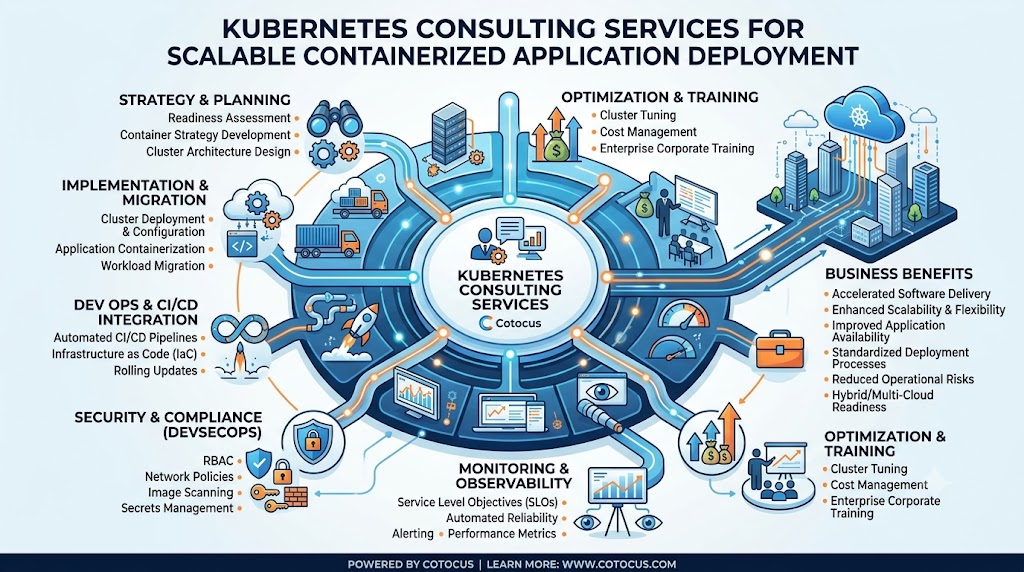
Kubernetes Consulting Services help organizations design, implement, optimize, and manage Kubernetes environments tailored to business and technical requirements.
Typical consulting engagements include:
- Kubernetes readiness assessment
- Container strategy development
- Cluster architecture design
- Cluster deployment and configuration
- Application containerization
- Workload migration
- Security hardening
- Monitoring and observability
- High availability planning
- Disaster recovery strategy
- Platform optimization
- Enterprise Kubernetes training
The objective is to create secure, scalable, and highly available Kubernetes environments that support continuous software delivery.
Containerization as the Foundation of Cloud-Native Applications
Containers package applications and their dependencies into lightweight, portable units that run consistently across environments.
Benefits of containerization include:
- Consistent deployments
- Faster application startup
- Improved portability
- Better resource utilization
- Simplified application packaging
- Faster software delivery
Kubernetes builds on these advantages by automating the management of containerized workloads.
Kubernetes Cluster Architecture
A successful Kubernetes deployment begins with a well-designed architecture.
Consulting services help organizations define:
Control Plane Design
The control plane manages cluster operations, scheduling, networking, and resource allocation.
Worker Nodes
Worker nodes host containerized workloads and provide compute resources for applications.
Networking
Proper networking ensures secure communication between services, clusters, and external systems.
Storage
Persistent storage strategies enable stateful applications to operate reliably within Kubernetes environments.
Thoughtful architecture improves scalability, reliability, and operational efficiency.
Workload Migration to Kubernetes
Migrating existing applications to Kubernetes requires careful planning.
The migration process typically includes:
- Application assessment
- Dependency analysis
- Containerization
- Deployment planning
- Data migration
- Performance testing
- Validation
- Production rollout
Consultants help organizations minimize disruption while modernizing application deployment.
DevOps and Kubernetes
Kubernetes works most effectively when integrated with DevOps practices.
Consulting services often include:
Continuous Integration
Automated build pipelines prepare container images for deployment.
Continuous Delivery
Applications move automatically through testing and production environments using CI/CD pipelines.
Infrastructure as Code
Clusters and supporting infrastructure are provisioned consistently through automation.
Automated Deployments
Rolling updates, canary deployments, and blue-green deployment strategies improve release reliability.
Together, DevOps and Kubernetes enable faster and more predictable software delivery.
Security in Kubernetes Environments
Security must be integrated into every stage of Kubernetes implementation.
Important security practices include:
- Role-Based Access Control (RBAC)
- Network policies
- Secrets management
- Image vulnerability scanning
- Pod security standards
- Identity management
- Runtime security
- Compliance monitoring
DevSecOps practices ensure that Kubernetes environments remain secure while supporting continuous deployment.
Monitoring and Observability
Modern container platforms require comprehensive visibility into application performance and infrastructure health.
Monitoring strategies include:
- Application performance monitoring
- Container metrics
- Cluster health monitoring
- Log aggregation
- Distributed tracing
- Alerting
- Capacity analysis
Observability enables engineering teams to detect and resolve issues before they affect users.
Site Reliability Engineering for Kubernetes
Site Reliability Engineering (SRE) enhances Kubernetes operations through automation and measurable reliability objectives.
SRE practices include:
- Service Level Indicators (SLIs)
- Service Level Objectives (SLOs)
- Incident response
- Capacity planning
- Reliability automation
- Performance optimization
- Production stability
These practices improve service availability while reducing operational risk.
Platform Engineering and Internal Developer Platforms
Many enterprises build internal developer platforms using Kubernetes to simplify software delivery.
Platform engineering provides:
- Self-service application deployment
- Standardized development environments
- Automated infrastructure provisioning
- Consistent governance
- Improved developer experience
- Faster onboarding
These platforms increase engineering productivity while simplifying operational management.
Infrastructure Automation
Infrastructure automation simplifies Kubernetes deployment and ongoing management.
Automation supports:
- Cluster provisioning
- Node configuration
- Policy enforcement
- Environment consistency
- Disaster recovery
- Infrastructure scaling
Infrastructure as Code ensures repeatable and reliable Kubernetes deployments across multiple environments.
Enterprise Kubernetes Training
Technology adoption succeeds when engineering teams develop practical operational skills.
Corporate Kubernetes training often includes:
- Kubernetes fundamentals
- Cluster administration
- Application deployment
- Networking
- Storage
- Security
- Monitoring
- DevOps integration
- Troubleshooting
- Operational best practices
Hands-on learning prepares teams to manage production Kubernetes environments with confidence.
Business Benefits of Kubernetes Consulting Services
Organizations implementing Kubernetes through structured consulting often achieve measurable improvements.
| Traditional Application Deployment | Kubernetes-Based Deployment |
|---|---|
| Manual deployments | Automated container orchestration |
| Static infrastructure | Dynamic scaling |
| Environment inconsistencies | Standardized deployments |
| Manual resource allocation | Automated scheduling |
| Limited scalability | Elastic workload management |
| Separate deployment tools | Unified orchestration platform |
| Reactive operations | Continuous monitoring and automation |
| Slow software releases | CI/CD-enabled deployments |
| Complex infrastructure management | Centralized container management |
Why Enterprises Choose Cotocus
Successful Kubernetes adoption requires technical expertise, operational planning, and practical implementation experience.
Cotocus helps enterprises implement Kubernetes through consulting, architecture design, workload migration, infrastructure automation, DevOps integration, DevSecOps practices, Site Reliability Engineering, platform engineering, CI/CD optimization, cloud consulting, and enterprise corporate training. By combining consulting services with knowledge transfer, Cotocus enables organizations to build long-term Kubernetes capabilities that support scalable and reliable software delivery.
Frequently Asked Questions
What are Kubernetes Consulting Services?
Kubernetes Consulting Services help organizations design, deploy, secure, optimize, and manage Kubernetes environments for containerized applications.
Why is Kubernetes important for enterprises?
Kubernetes automates container orchestration, improves scalability, enhances application availability, and simplifies cloud-native application management.
What is containerization?
Containerization packages applications and their dependencies into portable units that run consistently across different environments.
How does Kubernetes support DevOps?
Kubernetes integrates with CI/CD pipelines, Infrastructure as Code, automated deployments, and cloud-native development practices to accelerate software delivery.
How is security managed in Kubernetes?
Security includes RBAC, network policies, secrets management, vulnerability scanning, runtime protection, and continuous compliance monitoring.
What role does Site Reliability Engineering play?
SRE improves Kubernetes operations through monitoring, automation, incident response, capacity planning, and service reliability management.
Why is Infrastructure as Code important?
Infrastructure as Code automates Kubernetes infrastructure deployment, ensuring consistency, repeatability, and simplified environment management.
Can Kubernetes support multi-cloud deployments?
Yes. Kubernetes provides a consistent platform for managing containerized workloads across on-premises, public cloud, private cloud, and hybrid cloud environments.
Why should enterprises invest in Kubernetes training?
Corporate training equips engineering teams with practical skills needed to deploy, manage, troubleshoot, and optimize Kubernetes environments effectively.
Why choose Cotocus for Kubernetes consulting?
Cotocus combines Kubernetes expertise with DevOps consulting, infrastructure automation, DevSecOps, Site Reliability Engineering, platform engineering, cloud consulting, and enterprise training to help organizations build secure, scalable, and highly available container platforms.
Conclusion
Kubernetes Consulting Services enable enterprises to modernize application deployment through scalable container orchestration, automation, cloud-native architecture, and operational excellence. By combining Kubernetes with DevOps, infrastructure automation, DevSecOps, Site Reliability Engineering, and platform engineering, organizations can accelerate software delivery while improving reliability, security, and scalability.
Cotocus partners with enterprises throughout the Kubernetes adoption journey by providing consulting, implementation guidance, cloud expertise, automation strategies, and corporate training. Whether your organization is beginning its containerization journey or expanding existing Kubernetes environments, https://www.cotocus.com/ offers the expertise and enterprise services needed to build resilient, scalable, and future-ready application platforms.