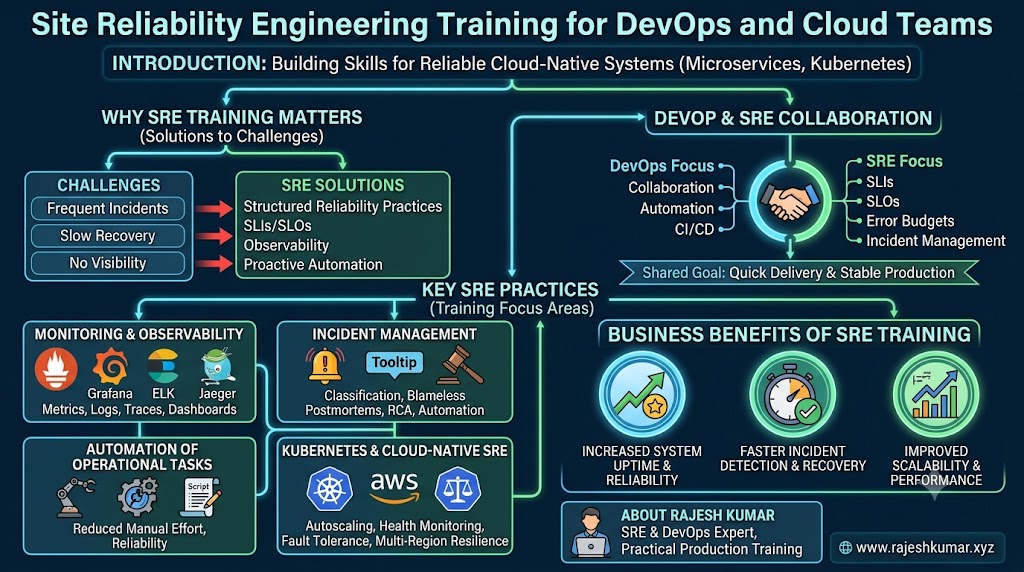
Introduction
Modern cloud-native systems are built for speed, scalability, and continuous delivery, but they also introduce new operational complexity. As organizations adopt microservices, Kubernetes, and distributed architectures, ensuring system reliability becomes a critical challenge.
This is where Site Reliability Engineering (SRE) Training plays a key role. It helps DevOps and cloud teams build the skills needed to maintain highly available, fault-tolerant, and observable systems in production environments.
Instead of relying only on traditional operations practices, SRE introduces engineering-driven approaches to reliability, incident response, and system monitoring.
Who Is Rajesh Kumar?
Rajesh Kumar is an experienced DevOps, SRE, and cloud engineering professional who helps organizations adopt modern engineering practices for scalable and reliable systems.
His expertise focuses on practical, production-oriented training in:
- Site Reliability Engineering practices
- DevOps automation and CI/CD pipelines
- Kubernetes and container orchestration
- DevSecOps and secure delivery pipelines
- Cloud-native architecture and platform engineering
He works with enterprise teams to improve reliability, reduce downtime, and build strong operational maturity across cloud environments.
More details are available at: https://www.rajeshkumar.xyz/
Rajesh Kumar DevOps Consulting & Training
Why Site Reliability Engineering Training Matters
As systems grow in scale and complexity, traditional IT operations models struggle to keep up with modern cloud environments. Teams often face:
- Frequent production incidents
- Slow recovery from outages
- Lack of visibility into system health
- Inefficient monitoring and alerting
- Poor capacity planning
Site Reliability Engineering Training helps solve these challenges by introducing structured reliability practices that combine software engineering with operations.
Key focus areas include:
- Reliability engineering principles
- Monitoring and observability
- Incident response workflows
- Automation of operational tasks
- Performance and scalability management
DevOps and SRE Working Together
DevOps focuses on collaboration, automation, and continuous delivery, while SRE builds on these principles to ensure system reliability and stability.
SRE adds structure through:
- Service Level Indicators (SLIs)
- Service Level Objectives (SLOs)
- Error budgets
- Incident management frameworks
- Reliability-driven decision making
Together, DevOps and SRE ensure that systems are not only delivered quickly but also remain stable in production environments.
Site Reliability Engineering Training for DevOps Teams
For DevOps and cloud teams, SRE training provides practical skills to manage production systems effectively.
It includes:
- Designing and tracking SLIs and SLOs
- Building monitoring dashboards
- Setting up alerting systems
- Managing on-call rotations
- Automating repetitive operational tasks
This training helps DevOps teams shift from reactive firefighting to proactive system reliability engineering.
SRE Consultant for Enterprise Cloud Reliability
An experienced SRE Consultant helps organizations design and implement reliability frameworks at scale.
Key responsibilities include:
- Building observability strategies
- Defining incident management processes
- Improving system resilience
- Implementing automation for recovery
- Establishing reliability metrics across services
This ensures cloud environments are stable, measurable, and continuously improving.
Monitoring and Observability in SRE Training
Monitoring and observability are essential components of SRE practices.
Key elements include:
- Metrics collection for system performance
- Centralized logging systems
- Distributed tracing across services
- Real-time alerting mechanisms
- Dashboard-driven visibility
These tools help teams detect issues early and reduce downtime in production systems.
Incident Management in SRE Training
Incident management is a core part of SRE practices and focuses on minimizing system downtime and improving recovery speed.
Key practices include:
- Incident classification and severity handling
- Root cause analysis
- Blameless postmortems
- Incident response automation
- Continuous improvement cycles
This structured approach ensures teams learn from failures and prevent recurring issues.
Kubernetes and Cloud-Native SRE Practices
Modern applications often run on Kubernetes and cloud platforms, making SRE even more important.
SRE practices in these environments include:
- Cluster health monitoring
- Autoscaling and resource optimization
- Load balancing strategies
- Fault tolerance design
- Multi-region resilience
These practices ensure cloud-native systems remain stable under high demand and unpredictable workloads.
DevSecOps in Site Reliability Engineering
Security is an integral part of modern reliability engineering.
SRE training integrates DevSecOps practices such as:
- Secure CI/CD pipelines
- Vulnerability scanning
- Secrets management
- Role-based access control
- Compliance automation
This ensures that reliability does not come at the cost of security.
Tools and Technologies Covered
| Area | Tools / Topics | Business Value |
|---|---|---|
| Monitoring | Prometheus, Grafana | Real-time system visibility |
| Logging | ELK Stack | Centralized log analysis |
| Tracing | OpenTelemetry, Jaeger | End-to-end observability |
| CI/CD | Jenkins Training | Reliable deployment pipelines |
| Infrastructure | Terraform Training | Infrastructure automation |
| Containers | Docker Kubernetes Training | Scalable application delivery |
| Cloud | AWS DevOps | Cloud-native reliability |
| Security | DevSecOps | Secure operations |
| Reliability | SLO/SLI frameworks | Predictable system behavior |
| Automation | SRE practices | Reduced manual intervention |
Why Choose Site Reliability Engineering Training
Organizations invest in SRE training because it delivers:
- Higher system uptime and reliability
- Faster incident detection and recovery
- Better observability and monitoring
- Reduced operational overhead
- Improved scalability and performance
- Stronger automation practices
- More predictable system behavior
It helps teams build a culture of reliability and continuous improvement.
Best Fit Audience
This training is ideal for:
- DevOps engineers
- Cloud engineers
- Site reliability engineers
- Platform engineering teams
- Software developers in distributed systems
- IT operations teams
- Engineering managers
- Enterprise cloud teams
It is especially valuable for organizations running cloud-native and Kubernetes-based systems.
Business Benefits of SRE Training
Organizations adopting SRE practices experience:
- Reduced downtime and outages
- Faster incident resolution
- Improved system performance
- Better scalability under load
- Enhanced monitoring and visibility
- Lower operational risk
- Increased customer satisfaction
- Stronger engineering efficiency
These improvements directly impact business continuity and operational excellence.
FAQs
Why is Site Reliability Engineering Training important?
It helps DevOps and cloud teams build skills in reliability, monitoring, and incident management for production systems.
What does an SRE Consultant do?
An SRE Consultant designs reliability frameworks, improves monitoring, and enhances incident response processes.
Who should attend SRE Training?
DevOps engineers, cloud engineers, and operations teams managing production systems should attend.
How does SRE improve system reliability?
It introduces SLIs, SLOs, automation, and structured incident management to reduce downtime.
Is SRE relevant for Kubernetes environments?
Yes, SRE is essential for managing reliability, scaling, and monitoring in Kubernetes-based systems.
Conclusion
Site Reliability Engineering has become a critical discipline for modern DevOps and cloud teams managing complex distributed systems. It ensures that applications remain reliable, scalable, and observable in production environments.
Through structured Site Reliability Engineering Training, teams gain practical skills in monitoring, incident management, automation, and cloud-native reliability practices.
Organizations looking to strengthen their engineering reliability and operational excellence can explore expert-led training and consulting at:
https://www.rajeshkumar.xyz/
With the right SRE foundation, teams can achieve higher uptime, faster recovery, and more stable cloud operations.