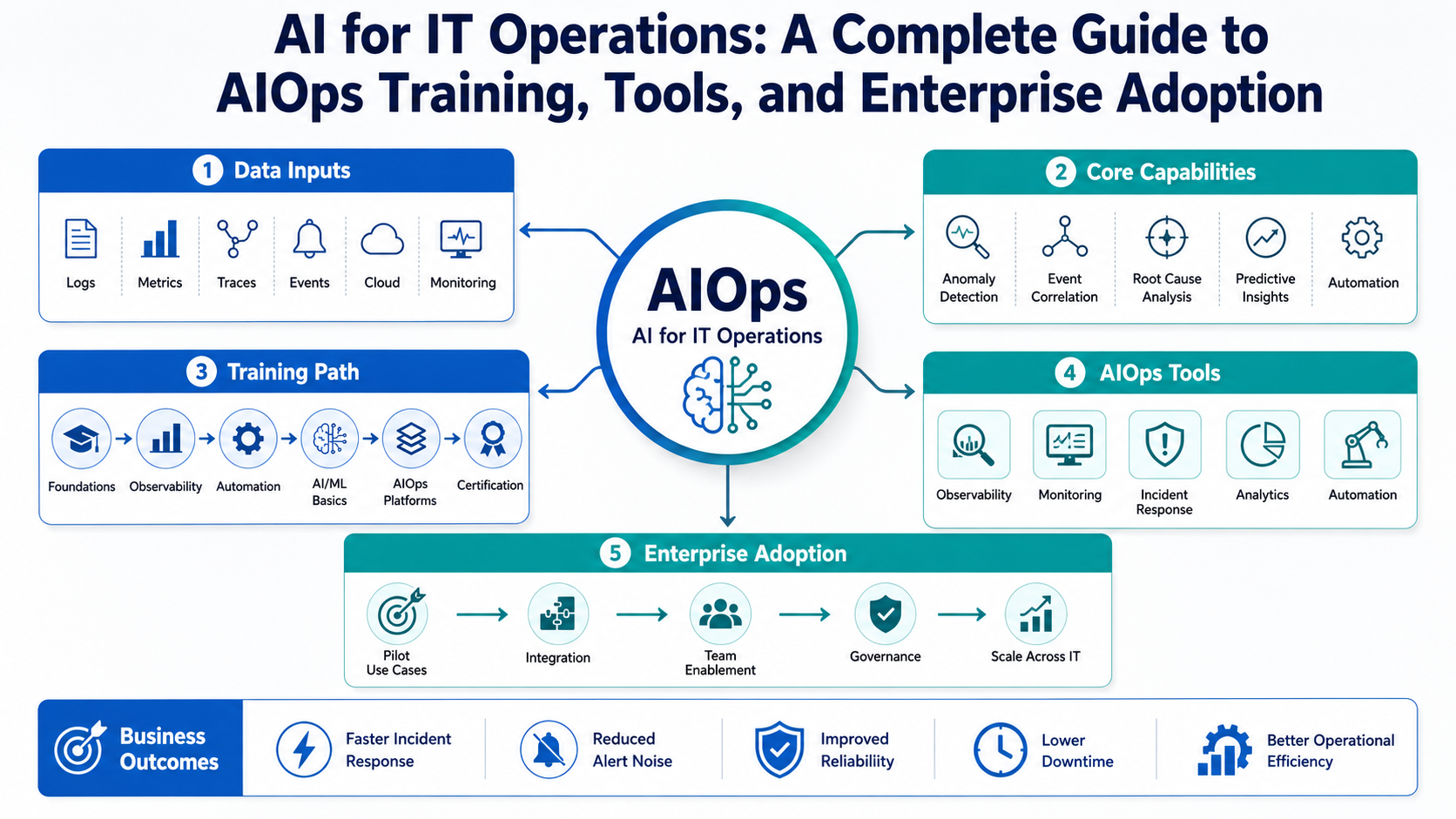
Introduction
Modern IT environments generate enormous amounts of operational data from applications, servers, cloud platforms, networks, security systems, and monitoring tools. As organizations continue to expand their digital infrastructure, traditional IT operations teams often struggle to manage alerts, identify root causes, and resolve incidents quickly.
Artificial Intelligence for IT Operations, commonly known as AIOps, has emerged as a powerful solution to these challenges. By combining artificial intelligence, machine learning, big data analytics, and automation, AIOps helps organizations detect anomalies, correlate events, predict issues, and automate operational workflows.
This comprehensive guide explains what AIOps is, how it works, the benefits it provides, the most popular AIOps tools, training and certification pathways, and how enterprises are adopting AIOps to transform modern IT operations.
What is AIOps?
AIOps stands for Artificial Intelligence for IT Operations. It refers to the use of artificial intelligence and machine learning technologies to automate and enhance IT operations processes.
The term was originally introduced to describe platforms that analyze large volumes of operational data and use intelligent algorithms to identify patterns, detect anomalies, predict incidents, and automate responses.
AIOps enables organizations to:
- Monitor complex IT environments
- Detect abnormal behavior automatically
- Reduce alert fatigue
- Accelerate incident response
- Improve service reliability
- Enable proactive operations management
Rather than relying solely on manual analysis, AIOps systems continuously learn from operational data and help teams make faster and more informed decisions.
Why AIOps Matters
Today’s IT environments are more complex than ever due to:
- Multi-cloud architectures
- Hybrid infrastructure
- Microservices
- Containers and Kubernetes
- Continuous deployment pipelines
- Distributed applications
- Remote work environments
Traditional monitoring tools often generate thousands of alerts every day. Operations teams can become overwhelmed trying to identify which alerts represent real problems.
AIOps helps solve these challenges by intelligently analyzing operational data and identifying meaningful insights that humans might otherwise miss.
Core Components of AIOps
Data Collection
AIOps platforms collect information from multiple sources, including:
- Application logs
- System metrics
- Network devices
- Monitoring tools
- Cloud platforms
- Security systems
- Service management tools
Big Data Processing
The collected information is aggregated and normalized to create a unified operational view.
Machine Learning Analytics
Machine learning models identify patterns, trends, and relationships within operational data.
Event Correlation
AIOps platforms connect related events and alerts to identify a single root cause rather than treating every alert separately.
Anomaly Detection
The system continuously monitors normal behavior and automatically identifies unusual patterns.
Automation and Remediation
Many AIOps platforms can trigger automated workflows to resolve common issues without human intervention.
How AIOps Works
A typical AIOps workflow follows these steps:
Step 1: Data Ingestion
Data is collected from monitoring systems, logs, applications, networks, and infrastructure.
Step 2: Data Normalization
Different formats and sources are standardized into a common framework.
Step 3: Pattern Recognition
Machine learning algorithms identify behavioral patterns and relationships.
Step 4: Event Correlation
Related alerts are grouped together to reduce noise.
Step 5: Root Cause Analysis
The platform identifies likely causes of incidents.
Step 6: Automated Response
Predefined automation workflows can remediate issues automatically.
Step 7: Continuous Learning
The system learns from historical events and improves future recommendations.
Key Benefits of AIOps
Faster Incident Detection
AIOps can identify issues before users experience service disruptions.
Reduced Alert Noise
Intelligent correlation significantly reduces duplicate and irrelevant alerts.
Improved Root Cause Analysis
Operations teams spend less time investigating incidents.
Enhanced Service Reliability
Proactive monitoring helps prevent outages and performance degradation.
Increased Operational Efficiency
Automation reduces manual effort and repetitive tasks.
Better Resource Utilization
AIOps can identify inefficiencies and optimize infrastructure resources.
Lower Operational Costs
Reduced downtime and improved productivity help lower overall IT expenses.
Common AIOps Use Cases
Intelligent Monitoring
AIOps continuously analyzes operational data to identify abnormalities and performance issues.
Predictive Maintenance
Machine learning predicts potential failures before they occur.
Incident Management
Automated event correlation accelerates incident resolution.
Capacity Planning
AIOps forecasts future resource requirements based on usage trends.
Security Monitoring
Anomaly detection helps identify unusual activities that may indicate security threats.
Cloud Operations
AIOps assists organizations in managing complex cloud environments.
Site Reliability Engineering
SRE teams use AIOps to improve system reliability and operational efficiency.
AIOps and Observability
Observability focuses on understanding system behavior through:
- Logs
- Metrics
- Traces
AIOps enhances observability by applying intelligence to collected telemetry data.
Together, observability and AIOps provide:
- Faster troubleshooting
- Improved visibility
- Better operational insights
- Automated decision-making
AIOps vs Traditional IT Operations
| Feature | Traditional IT Operations | AIOps |
|---|---|---|
| Alert Handling | Manual | Automated |
| Incident Detection | Reactive | Proactive |
| Root Cause Analysis | Human Investigation | AI-Assisted |
| Event Correlation | Limited | Advanced |
| Automation | Basic | Intelligent |
| Scalability | Limited | High |
| Predictive Insights | Rare | Built-In |
AIOps vs DevOps
While both improve IT operations, they serve different purposes.
DevOps Focus
- Collaboration
- CI/CD
- Faster software delivery
- Infrastructure automation
AIOps Focus
- Intelligent operations
- Incident prediction
- Root cause analysis
- Operational automation
Organizations increasingly use DevOps and AIOps together to create highly efficient technology environments.
AIOps vs MLOps
AIOps
Focuses on managing IT operations using AI technologies.
MLOps
Focuses on managing machine learning models throughout their lifecycle.
While both leverage machine learning, their objectives differ significantly.
Popular AIOps Tools
Dynatrace
Known for AI-powered observability and automatic root cause analysis.
Datadog
Provides monitoring, analytics, and intelligent operational insights.
Splunk ITSI
Offers event correlation, predictive analytics, and operational intelligence.
IBM Watson AIOps
Combines AI and automation to accelerate incident management.
Moogsoft
Specializes in event correlation and noise reduction.
BigPanda
Focuses on operational intelligence and incident management.
New Relic
Provides observability with AI-powered analytics.
LogicMonitor
Offers infrastructure monitoring and anomaly detection capabilities.
PagerDuty
Supports incident response automation and operational workflows.
Elastic Observability
Combines observability and machine learning-driven insights.
Enterprise Adoption of AIOps
Organizations across industries are implementing AIOps to improve operational performance.
Banking
Banks use AIOps for transaction monitoring, system reliability, and fraud detection.
Healthcare
Healthcare providers use AIOps to ensure system availability and improve patient care services.
Telecommunications
Telecom operators leverage AIOps for network monitoring and service optimization.
E-Commerce
Online retailers use AIOps to prevent downtime during peak traffic periods.
Manufacturing
Manufacturers apply AIOps to support predictive maintenance and operational efficiency.
Skills Required for AIOps Professionals
Successful AIOps professionals typically develop expertise in:
- IT Operations
- Cloud Computing
- Linux Administration
- Monitoring Tools
- Automation
- Python Programming
- Data Analytics
- Machine Learning Fundamentals
- Site Reliability Engineering
- Incident Management
AIOps Training Roadmap
Phase 1: Foundations
Learn:
- Linux
- Networking
- Cloud fundamentals
- Monitoring basics
Phase 2: Automation
Study:
- Python
- Bash scripting
- Infrastructure automation
Phase 3: Observability
Learn:
- Metrics
- Logs
- Distributed tracing
- Monitoring platforms
Phase 4: AI and Analytics
Understand:
- Machine learning basics
- Data analysis
- Predictive analytics
Phase 5: AIOps Platforms
Gain hands-on experience with enterprise AIOps tools.
AIOps Certification Benefits
Professional certification helps individuals:
- Validate skills
- Improve career prospects
- Increase industry credibility
- Demonstrate practical expertise
- Gain employer recognition
Organizations also benefit by developing teams capable of managing modern IT environments effectively.
Challenges of AIOps Adoption
Despite its advantages, organizations may face several challenges:
Data Quality Issues
Poor data quality can affect AI accuracy.
Integration Complexity
Connecting multiple systems requires careful planning.
Skill Gaps
Teams may need additional training to utilize AIOps effectively.
Change Management
Organizations must adapt processes and workflows.
Initial Investment
Implementing enterprise-grade AIOps platforms may require significant investment.
Best Practices for AIOps Implementation
Start Small
Begin with a specific use case before scaling.
Improve Data Quality
Ensure operational data is accurate and consistent.
Integrate Existing Tools
Leverage current monitoring and observability investments.
Focus on Automation
Automate repetitive tasks wherever possible.
Train Operations Teams
Develop skills in AI-driven operations management.
Measure Outcomes
Track metrics such as:
- Mean Time to Detect
- Mean Time to Resolve
- Alert Reduction
- Service Availability
The Future of AIOps
The future of AIOps is closely connected with advancements in artificial intelligence, generative AI, automation, and observability.
Emerging trends include:
- Autonomous IT operations
- Self-healing systems
- Generative AI-assisted troubleshooting
- Predictive incident prevention
- Intelligent automation at scale
- AI-powered operational assistants
As enterprise environments continue to grow in complexity, AIOps will play an increasingly important role in ensuring reliability, performance, and operational efficiency.
Conclusion
AIOps represents a significant evolution in the way organizations manage IT operations. By combining artificial intelligence, machine learning, big data analytics, and automation, AIOps enables businesses to move from reactive operations to proactive and predictive management. Organizations can reduce alert fatigue, accelerate incident resolution, improve service reliability, and enhance operational efficiency across complex digital environments.